
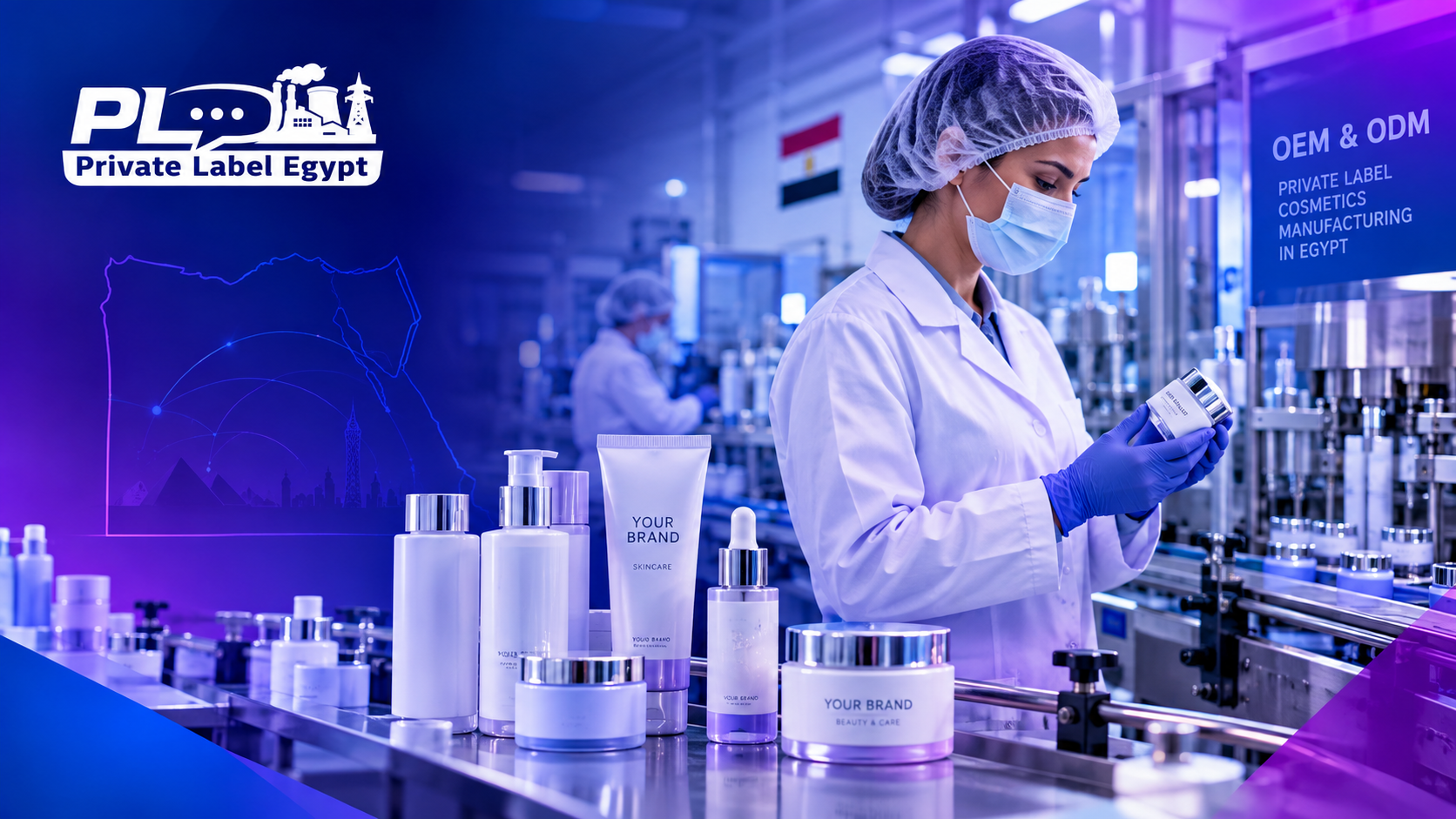
Short answer: to launch a private-label cosmetics brand in Egypt you need three things: a factory licensed by the Egyptian Drug Authority (EDA) with a production line for your product, a contract-manufacturing ("toll") agreement in your company's name, and an EDA listing for every product through the EgyCosm platform before you sell or advertise it. The listing number is issued within 10 working days (3 on the fast track) once the file is complete and fees are paid, and it stays valid for 10 years. The whole project, from idea to first batch, usually takes 3 to 6 months; the longest step is stability testing, which rarely takes less than 4 to 6 weeks.
This guide covers the current legal framework (EDA Chairman Decree No. 122 of 2022), the difference between manufacturing models, the documents and tests you need, mandatory label content, claims the EDA rejects, and the mistakes that most often delay new brands or cost them extra fees.
Key takeaways
No cosmetic product may be sold or imported in Egypt before it is listed in the EDA database and has a listing number (Decree 122/2022, Article 2).
You can own the brand and manufacture at someone else's factory as a "toll company", provided the factory is licensed and its licence covers the right production line.
Perfumes, colognes, all soaps and single raw oils sold without medical claims are exempt from EDA listing; they fall under the Egyptian Organization for Standardization and Quality (EOS).
Every product needs a Product Information File (PIF) with a safety assessment, kept for 10 years after the last batch is marketed.
Claims such as "slimming", "body shaping", "prevents stretch marks" and "anti-cellulite" are rejected for cosmetics.
What does private label mean in cosmetics?
Private-label manufacturing means a factory produces a product that is sold under your brand name and design, while you handle marketing and sales. It is often confused with two neighbouring models, and the difference determines your cost, your timeline and who owns the formula:
| Model | Formula source | Customisation | Formula ownership | Indicative production time* |
|---|---|---|---|---|
| White label | Factory's ready formula | Packaging and label only | Factory | 4–6 weeks |
| Private label | Factory's formula catalogue | Limited: fragrance, colour, texture | Usually the factory | 4–8 weeks |
| Custom / OEM | Developed for you from scratch | Full | You | 8–14 weeks |
* Indicative figures published for a European market (Cosmetic Lab, May 2026); they exclude Egyptian listing time. Actual timelines vary by factory and product.
Under Egyptian law, the closest equivalent to private label is contract manufacturing: a company lists a product in its own name and has it made in a factory it does not own. The EDA calls it a "toll company" (Decree 122/2022, Article 1).
The Egyptian market in numbers
IMARC Group valued Egypt's beauty and personal care market at about USD 1.96 billion in 2025 and expects USD 3.23 billion by 2034, a 5.43% CAGR (May 2026 update). Estimates vary: MarkNtel puts 2025 at about USD 1.75 billion.
Skin care and hair care lead demand, men's grooming is growing, and interest in natural and herbal products is rising.
Egypt had 98.2 million internet users (82.7% of the population), and TikTok ads reach 65.5% of adults (DataReportal, Digital 2026).
E-commerce revenue reached about USD 2.34 billion in 2025 (ECDB), led by Amazon and Noon.
In practice: demand exists and is growing, and reaching consumers online is relatively cheap, so regulatory compliance and formula quality are what set a new brand apart, not visibility alone.
The legal framework: what does EDA Decree 122 of 2022 require?
Decree No. 122 of 2022 governs the listing and circulation of cosmetics. It was published in the Egyptian Gazette on 28 February 2022 and uses the EU Cosmetics Regulation (EC 1223/2009) and COLIPA guidelines as its evaluation reference. What matters most for a brand owner:
List before you sell or advertise: no circulation or import without a listing number (Art. 2), no advertising of an unlisted product (Art. 6), and advertising and claims must be notified to the EDA and match what was approved at listing (Art. 5).
Good manufacturing practice: the manufacturer must follow GMP, with ISO 22716 as the reference (Art. 7); the company must follow good storage practice.
Product Information File (PIF): includes the safety assessment report, the manufacturing method with a GMP statement, and proof of claimed effects. It must be in Arabic, or English with a certified Arabic translation, kept for 10 years after the last batch is marketed, and the safety assessment must be done before launch by an assessor who meets EDA conditions (Art. 8).
Responsibility and records: keep distributor records for 5 years (Art. 4); the company stays responsible for 5 years after the listing expires (Art. 11) and must follow recall and cosmetovigilance rules (Arts. 12–14).
What is exempt from EDA listing?
Perfumes, eau de toilette, cologne, all soaps (solid or liquid) and single raw oils sold as a finished product without medical claims. These fall under EOS supervision, including the mandatory standard ES 3570/2022 for perfumed solutions.
Documents needed to list a contract-manufactured product
According to the EDA's regulatory guide for cosmetics notification (EDREX:GL.CAPP.009), the product file includes:
The product's trade name, and the company name and address.
A composition form with the scientific name, percentage (w/w or w/v) and function of every ingredient.
Final artwork.
Shelf life.
The contract-manufacturing agreement, naming an EDA-licensed storage location.
Scientific references for every on-pack claim.
The fee receipt.
The manufacturing site is listed once on the "Manufacturing List", with approval in 3 working days, and the factory licence must include your product's line. Choose the registration type (local or toll) carefully: getting it wrong means rejection and new fees.
Steps from idea to shelf
Define the product and customer: start with one category (face wash, serum, shampoo…), a target segment and a target retail price; the price sets the ceiling for formula and packaging cost.
Choose the factory: ask for its licence and production lines, confirm ISO 22716 compliance, and request samples from its formula catalogue.
Approve the formula: ready, adjusted or custom, depending on budget and whether you want to own it.
Testing: stability and packaging compatibility, preservative efficacy, then the safety assessment and PIF.
Design and label: follow the mandatory label content (next section) and use only acceptable claims.
List on EgyCosm: once the factory is listed, submit the product file; the number is issued within 10 working days, or 3 on the fast track.
Production and release: the first batch ships with a certificate of analysis showing batch number, production date and expiry date.
Launch and advertise: do not advertise before the listing number is issued, and notify the EDA of advertising and claims.
Tests you should never skip
| Test | Purpose | Reference | Note |
|---|---|---|---|
| Stability and packaging compatibility | Confirm colour, odour, texture and efficacy hold throughout shelf life | ISO/TR 18811:2018 | Guidance only; the manufacturer defines and justifies the protocol; usually at least 4–6 weeks |
| Preservative efficacy (challenge test) | Prove the product resists microbial contamination | ISO 11930:2019 | Five micro-organisms over 28 days |
| Safety assessment | A report showing the product is safe for its intended use | Decree 122/2022, Art. 8 | Mandatory before launch; kept in the PIF |
Mandatory label content
Product name and trademark.
The listing holder's name and the manufacturer's name (for local and toll products).
Country of origin, and the listing number or barcode.
Net quantity (exempt below 15 ml or 15 g).
Directions and warnings; the intended use must be in Arabic for locally manufactured products.
An "Ingredients" list in English INCI names, in descending order of concentration (below 1% in any order).
Storage conditions, and the durability date or period-after-opening (PAO) symbol.
Claims the EDA rejects for cosmetics
The EDA claims guide (EDREX:GL.CAPP.010, version 5, April 2025) rejects claims including slimming, skin tightening and body contouring, anti-inflammatory, anti-hyperhidrosis, anti-cellulite and skin sagging, preventing stretch marks and anti-callus; anti-acne claims are judged case by case. Products containing non-biodegradable microbeads are also rejected. Rule of thumb: never print a claim before you know how you will prove it.
Cost and minimum order quantity
There is no official price list for manufacturing; cost depends on formula, packaging type, fill size and quantity. The main drivers:
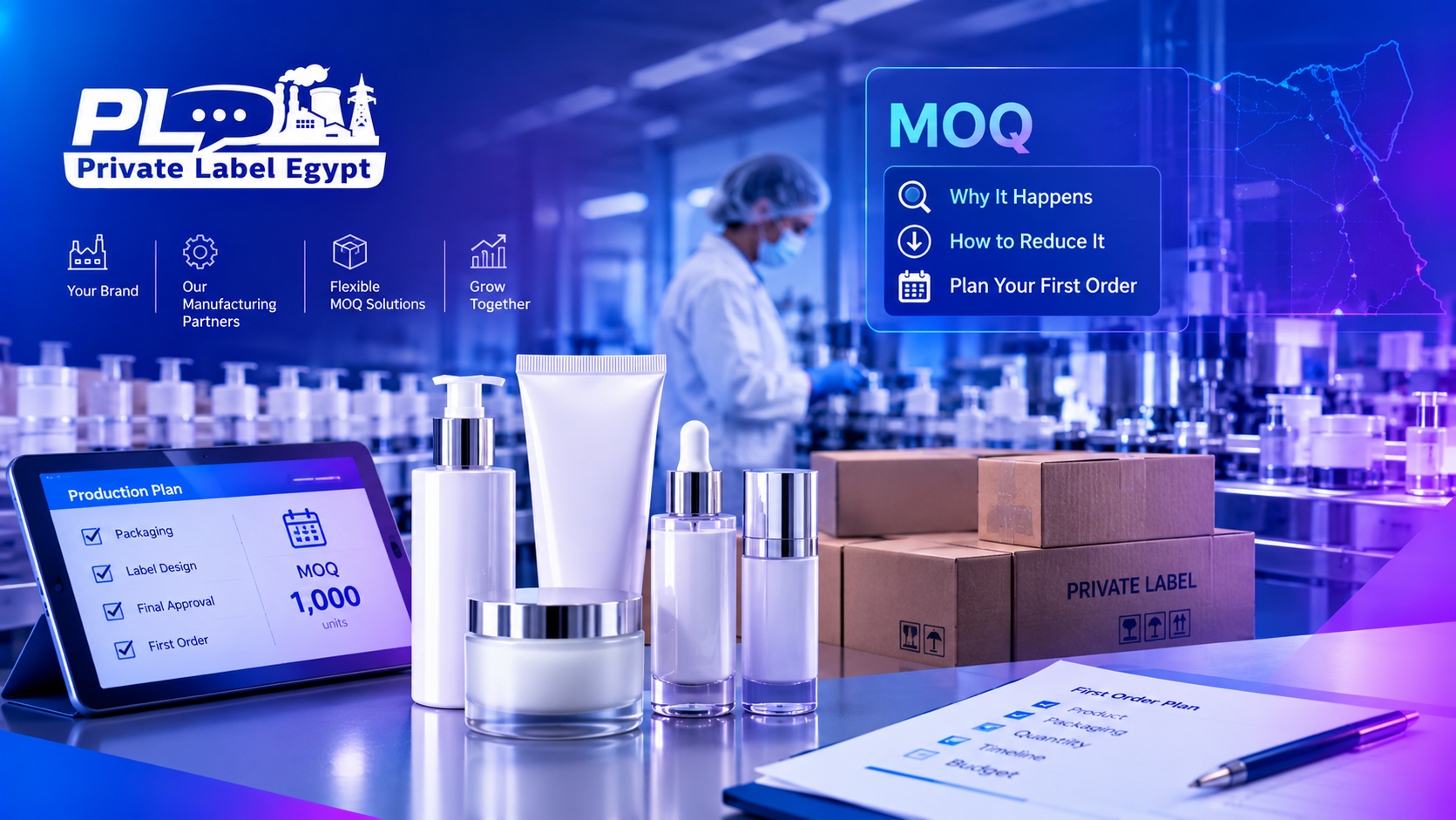
MOQ: some factories start at a few hundred units for a ready formula; it rises with customisation and custom-printed packaging.
Packaging: often costs more than the formula itself, especially glass and airless packs.
Custom formula development and testing: a fixed cost spread over the batch, so unit cost falls as quantity rises.
Listing fees: set by EDA decrees and revised from time to time; check the current fee schedule before applying, and budget separately for each extra size, colour or fragrance.
The most reliable way to learn your real cost is to compare quotes from several factories against the same specification.
Common mistakes that delay new brands
Skipping stability or preservative testing to launch sooner.
Choosing packaging for looks without testing compatibility; some ingredients, such as vitamin C, degrade with light and air.
Printing a rejected claim such as "slimming" or "treats acne".
Choosing the wrong registration type, or contracting a factory whose licence lacks the required line.
Ingredients on the artwork that differ from the composition form submitted to the EDA.
Advertising before the listing number is issued.
How to find the right cosmetics factory on PLEgypt
Instead of contacting factories one by one, create a request for quotation describing your product (category, size, quantity, packaging, level of customisation), and matching factories and suppliers will send offers you can compare on price, MOQ and lead time in one place. You can also browse the company directory and the manufacturing market, or browse the cosmetics category, hair care products and packaging and materials from suppliers.
Practical tip: before paying any deposit, ask each factory for a copy of its licence showing the production line, and evidence of ISO 22716 compliance.
Frequently asked questions
Do I have to list a cream with the EDA before selling it online?
Yes. Selling online is circulation, and no cosmetic may be circulated or advertised before it is listed and has a listing number.
How long does listing take?
The listing number is issued within 10 working days on the normal track or 3 working days on the fast track, once documents are complete and fees are paid. It is valid for 10 years.
Can I manufacture at another factory and register the product in my company's name?
Yes, as a toll company manufacturing with a third party, under a contract with a licensed factory whose licence covers the required line.
Do perfume and soap need EDA listing?
No. Perfumes, colognes and soaps are exempt from EDA listing and are supervised by EOS.
Is Arabic mandatory on the pack?
For locally manufactured products the intended use must be in Arabic and warnings and directions are basically in Arabic, while the ingredient list uses English INCI names.
Is halal certification mandatory for cosmetics in Egypt?
No, it is voluntary, though it can be a marketing advantage with some customer segments.
What is the smallest quantity I can manufacture?
The factory sets it based on formula and packaging; it is usually lower with ready formulas and standard packs, and higher with custom formulas and custom-printed packaging.
Sources
EDA Chairman Decree No. 122 of 2022 on the listing and circulation of cosmetics — edaegypt.gov.eg
EDA Regulatory Guide for Cosmetics Notification, EDREX:GL.CAPP.009 (March 2022) — edaegypt.gov.eg
EDA Cosmetics Claims Guide, EDREX:GL.CAPP.010, v5 (April 2025) — edaegypt.gov.eg
Egyptian Standards ES 8470/2021 (cosmetics GMP) and ES 3570/2022 — eos.org.eg
ISO 22716:2007, ISO 11930:2019, ISO/TR 18811:2018 — iso.org
IMARC Group, Egypt Beauty and Personal Care Market (May 2026 update); DataReportal Digital 2026 Egypt; ECDB
Last updated: September 2026. This guide is general information and does not replace checking with the official authorities or a regulatory specialist before applying.